

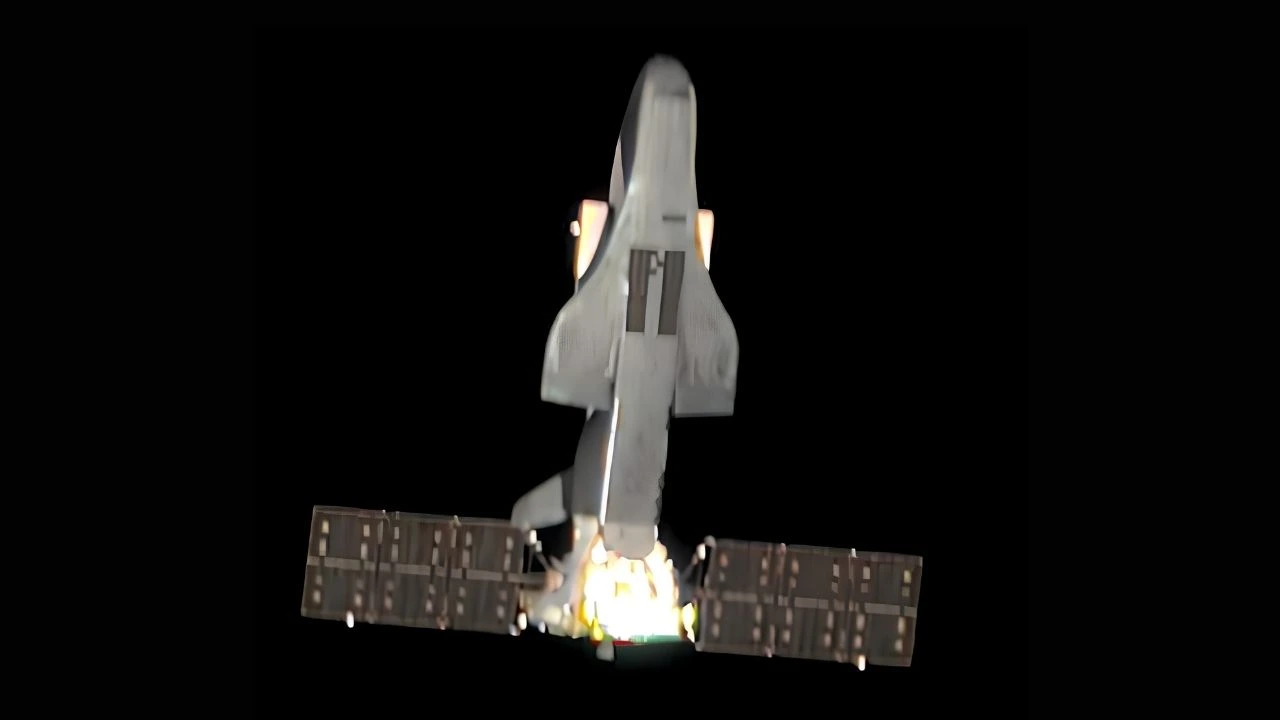
The U.S. Defense Intelligence Agency (DIA) published a 2024 photograph showing an uncrewed Chinese reusable spaceplane docked with a satellite in orbit. Released on October 26 in the third edition of the agency's Challenges to Security in Space report, the unclassified assessment details orbital activities conducted by China, Russia, Iran, and North Korea. Private U.S. satellite and space intelligence company Vantor, formerly known as Maxar, captured the photograph. In the image, the spacecraft's payload bay doors are open while the accompanying satellite has its solar panels deployed.
Shenlong and Tengyun Reusable Spaceplane Missions in China
The DIA included the Vantor photograph within a report section analyzing reusable space launch vehicles (R-SLVs). According to the intelligence assessment, the United States currently operates the only active R-SLV program, while China is working to become the second nation with that capability. Alongside reusable rockets, Beijing is building spaceplanes designed to provide both reusability and increased orbital maneuverability, the report stated.
According to the DIA document, China is developing two primary spaceplane models: the Shenlong, meaning Divine Dragon, and the Tengyun, which translates to Cloud Rider. While the agency did not confirm which model appears in the 2024 image, the spacecraft launched vertically atop a Long March rocket is widely assessed to be the uncrewed Shenlong, which has been compared to the X-37B spaceplane built by Boeing for the U.S. Space Force. According to official Chinese accounts, the Tengyun utilizes horizontal launch technology and remains in an earlier experimental phase, while Chinese state media previously referred to the active craft as a reusable experimental spacecraft.
The October 26 DIA publication documented three completed Chinese spaceplane flights: a two-day mission in 2020, a 276-day flight launched in August 2022, and a 268-day mission that began in December 2023. Following those three flights, Chinese state media reported that a fourth launch took place in February.
U.S. Defense Intelligence Agency Assessment of Orbital Security Threats
David Shedd, former acting director of the DIA, stated via email to VOA that the published photograph indicates China is actively working to expand both its offensive and defensive capabilities in orbit. According to Shedd, advancements by the People's Republic of China (PRC) require the United States to counter Chinese space capabilities that threaten American defense and commercial satellite constellations.
Operating under the U.S. Department of War, the DIA stated in its report—which follows previous editions released in early 2019 and 2022—that China, Russia, Iran, and North Korea are testing and deploying orbital systems that endanger global space security. According to the agency, these four nations have extended their activities into economic and diplomatic arenas. Although Beijing and Moscow led the United Nations to pass two resolutions in December 2025 aimed at preventing an orbital arms race and banning the first placement of weapons in space, the DIA characterized those measures as unverifiable commitments that have not halted hazardous orbital conduct. The Chinese government, which claims it opposes the weaponization of outer space, has not issued a specific response to the October 26 DIA report.