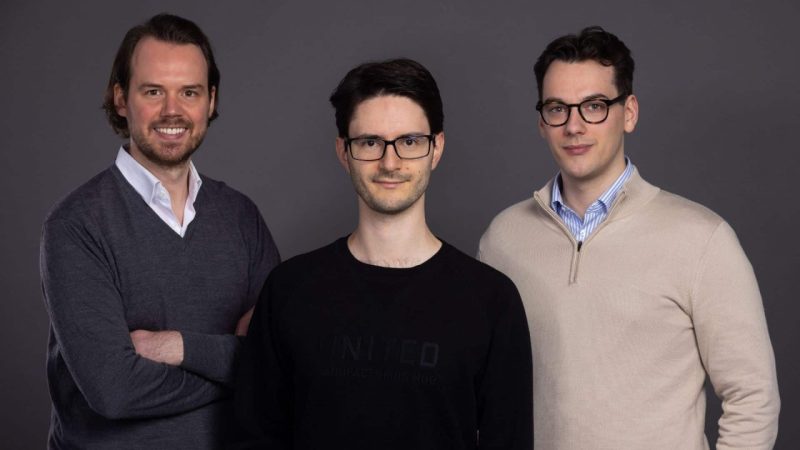
Vitrealab closes oversubscribed €9.4 million Series A
Vienna-based deeptech company Vitrealab, which develops Photonic Integrated Circuits (PICs) for laser-based augmented reality display systems, has raised €9.4 million (about $11 million) in a Series A financing round. The company said the round was “significantly oversubscribed” and will be used to accelerate development and industrialisation of its Quantum Light Chip (QLC), a core component designed to enable smaller, brighter and more energy-efficient AR light engines.
The round was led by LIFTT Italian Venture Capital and LIFTT EuroInvest. Additional investors include Constructor Capital, aws Gründungsfonds, Gateway Ventures, PhotonVentures, xista Science Ventures, Moveon Technologies, and Hermann Hauser Investment.
From advanced prototypes to industrial-grade solutions
According to the company, the new funding will help it transition from advanced prototypes toward manufacturing-ready products aimed at next-generation AR glasses. Dr Jonas Zeuner, CTO and co-founder of Vitrealab, said the Series A outcome supports the company’s roadmap to scale.
“The successful closing of our Series A is a strong validation of our technology and our vision for scalable AR display systems,” Dr Jonas Zeuner said. “This funding allows us to move from advanced prototypes to industrial-grade solutions, while continuing to push the boundaries of what is possible with photonic integrated circuits in display applications.”
Deeptech roots in Vienna’s quantum research ecosystem
Vitrealab was founded in 2018 by Chiara Greganti and Dr Jonas Zeuner as a spin-off from the Quantum Group at the University of Vienna. The company’s origins are tied to one of Europe’s best-known quantum research communities; one of the group’s founding members is Anton Zeilinger, who received the Nobel Prize in 2022.
The startup positions itself as a disruptor in the display industry, focusing on a new approach to laser waveguide technology. Its work targets a persistent bottleneck in AR hardware: delivering high-quality imagery in a compact form factor while keeping power consumption low enough for lightweight, all-day wearable devices.
What the Quantum Light Chip is designed to solve
Vitrealab develops PICs for laser–Liquid Crystal on Silicon (LCoS)-based AR light engines. In these systems, coherent laser light must be guided, shaped and delivered with high efficiency and stability. The company says its proprietary Quantum Light Chip enables compact, high-brightness and energy-efficient light engines, addressing both performance and scalability challenges that have slowed broader adoption of AR glasses.
At a technical level, the company’s approach uses photonic integrated circuits to guide and shape coherent laser light for laser–LCoS light engines. Vitrealab argues that integrating optical functionality onto a chip can reduce system complexity, shrink size and lower optical losses—while preserving polarisation and beam quality. Those attributes, the company says, translate into higher brightness, wider fields of view and lower power draw, all within form factors suitable for consumer-grade AR smart glasses.
Vertical integration and in-house manufacturing
One differentiator highlighted by Vitrealab is its vertically integrated model. Rather than relying entirely on external fabrication partners, the company says it has in-house manufacturing equipment and proprietary direct laser writing technologies that allow it to both design and fabricate photonic devices internally.
The strategy is intended to make the transition from prototype development to volume production “seamless,” a key challenge for photonics startups that must meet stringent manufacturing tolerances while also keeping costs in check. For AR, where consumer devices demand high yields and consistent performance at scale, industrialisation is often as critical as the underlying optical innovation.
How the company plans to deploy the new capital
Vitrealab said the Series A proceeds will be used to accelerate development and industrialisation of the QLC, strengthen collaborations with customers and partners, and demonstrate next-generation light-engine architectures. The company also aims to expand the technical capabilities required to support what it describes as the “everyday adoption” of AR displays.
While the company did not disclose specific commercial timelines, its stated focus on industrial-grade solutions suggests a push to meet the requirements of large hardware manufacturers evaluating AR components for future product lines.
Prior funding and market positioning
In 2021, Vitrealab closed a seven-digit seed round led by APEX Ventures, aimed at scaling its solutions in the display market. The company says it works with leading Tier-1 OEMs and technology partners, positioning its PIC-based light-engine components as enabling technology for mass-market AR glasses.
The Series A round underscores continued investor interest in enabling components for AR hardware, where advances in optical efficiency, compactness and manufacturability are seen as prerequisites for broader consumer adoption. For Vitrealab, the next phase will hinge on proving that its Quantum Light Chip can move beyond lab-grade performance into repeatable, cost-effective manufacturing suitable for high-volume devices.
Related