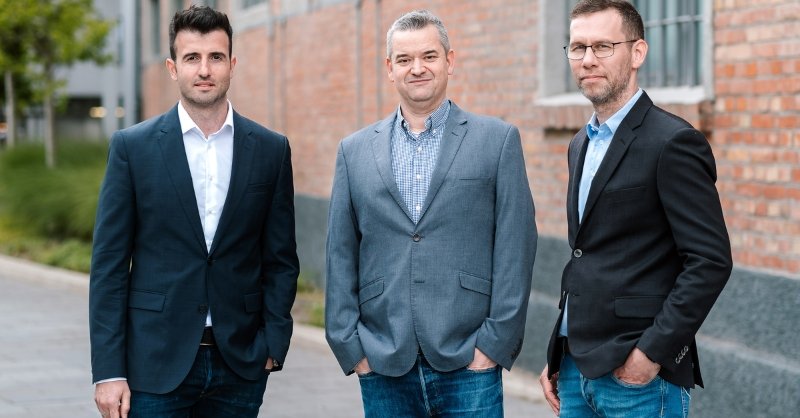
RobCo lands $100M to scale “Physical AI” robots for factories
RobCo, a Munich-based industrial robotics company, has raised $100 million in a Series C funding round to expand deployments of its autonomous robotics platform and accelerate growth in the United States. The round was co-led by Lightspeed Venture Partners and Lingotto Innovation, the investment firm backed by Exor, with participation from existing investors including Sequoia Capital, Greenfield Partners, Kindred Capital, Leitmotif, and The Friedkin Group.
The financing comes as manufacturers worldwide face intensifying pressure to automate amid labor shortages, rising operating costs, and production lines that are increasingly complex and frequently reconfigured. While industrial automation has long promised higher throughput and improved reliability, many factories still struggle with robots that can be expensive to maintain, time-consuming to deploy, and difficult to adapt when processes change.
Roman Hölzl, founder and CEO of RobCo, said the company plans to use the new capital to broaden enterprise deployments, advance its Physical AI roadmap, and strengthen its presence on both sides of the Atlantic. “With this $100 million, we are building the leading AI robotics company for manufacturing in the U.S. and Europe. Our goal is simple: automate repetitive work so people can focus on higher-value tasks,” Hölzl said.
Why factory automation still falls short
Factories increasingly need flexible automation, not just fixed robots programmed for a narrow set of repeatable motions. In many real-world production environments, tasks vary by product, shift, supplier, and workstation layout. Even small changes—such as repositioning a bin, swapping a component, or altering a sequence—can require costly reprogramming or integration work.
RobCo is positioning its platform as an answer to that gap: robots that can be deployed faster and adapt more readily to changing factory conditions. The company argues that the next wave of industrial robotics will be defined less by hard-coded routines and more by learning systems that improve with experience in real production settings.
What RobCo is building
Founded in 2020, RobCo develops a full-stack robotics platform that combines hardware and software into a single system. Rather than relying on complex manual programming, the company says its robots can learn tasks through demonstrations and self-learning—an approach intended to reduce setup time and enable quicker iteration when manufacturing processes shift.
The platform integrates key capabilities such as perception, motion planning, and learning, aiming to help manufacturers spend less time on integration and more time on operations. RobCo also describes its offering as a “single pane of glass,” suggesting customers can avoid piecing together multiple vendors across robot hardware, software tooling, and deployment support.
According to the company, additional investment will go into product development as the system learns from a growing base of real-world factory data, which it expects to compound over time—improving autonomy and broadening the range of tasks its robots can handle.
U.S. expansion accelerates
RobCo entered the U.S. market in 2025 and now operates from San Francisco and Austin. The company’s U.S. push aligns with broader trends in American manufacturing, including efforts to address labor constraints, support reshoring initiatives, and manage increasingly complex operations.
The company says its robots are already deployed across multiple industrial settings, including work with BMW and other firms in energy, manufacturing, and electronics. While RobCo did not disclose the number of robots deployed or revenue figures, it framed the Series C as a step toward scaling enterprise rollouts and deepening relationships with large industrial customers.
Investors bet on Physical AI in production
Lightspeed Venture Partners, which previously led RobCo’s Series B, said it is doubling down based on the company’s progress in real-world industrial environments. Alexander Schmitt of Lightspeed said the firm believes RobCo can become a global leader by combining systems that work today with a roadmap that increases capability over time through learning.
Morgan Samet, Managing Partner and Co-Head of Lingotto Innovation, pointed to autonomy as a growing competitive advantage in manufacturing. Samet said RobCo stands out for bringing Physical AI into production environments while laying out what the investor described as a step-by-step path toward higher autonomy—supporting people “where it matters most on the factory floor.”
What comes next
With fresh capital, RobCo plans to expand deployments, improve autonomy across its robotics platform, and reinforce long-term growth in both Europe and the U.S. The company’s strategy hinges on the idea that learning-based robotics will become more valuable as it accumulates more factory data, enabling faster adaptation to new tasks and environments.
For manufacturers, the promise is straightforward: automation that is less brittle, more scalable, and better aligned with the realities of modern production. For RobCo, the Series C is a major bet that the next generation of industrial robots will be defined by AI-driven learning in the messy, variable conditions of the factory floor—not just in controlled demos.
Related