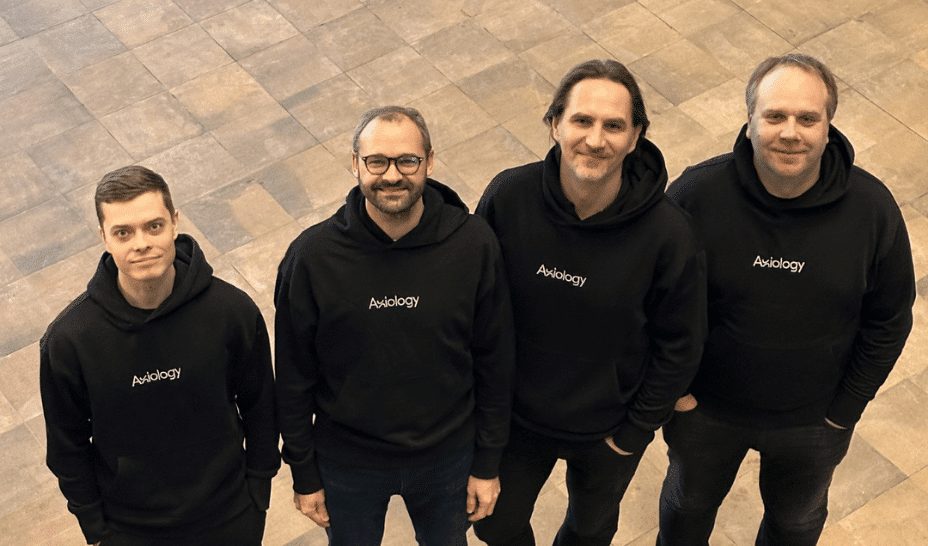
Axiology secures €5 million Seed round to scale tokenised capital markets
Vilnius-based capital markets infrastructure provider Axiology has raised €5 million in Seed funding to expand a regulated platform designed to support the full lifecycle of tokenised securities under the European Union’s DLT Pilot Regime. The company says the new capital will help it scale capabilities for digital fixed-income instruments by bringing issuance, custody, trading and settlement into a single compliant environment.
The round was led by Exponential Science, e2vc and Coinvest Capital, with participation from new investors TIBAS Ventures and Plug and Play. Existing backers, including BSV Ventures and NGL Ventures, also supported the financing. With this raise, Axiology has disclosed total funding of €7 million, following a €2 million round in 2024.
Building infrastructure around the EU’s DLT rules
Marius Jurgilas, Founder and CEO of Axiology, positioned the raise as a bet on market plumbing rather than policy alone. “Europe’s Savings and Investment Union won’t be built by policy alone – it needs new market infrastructure,” he said, pointing to the EU’s Market Integration Package and the DLT Pilot Regime as creating “legal space” for regulated experimentation. Axiology said its system is already live, and the new funding will be used to scale a unified platform aimed at European capital markets participants.
The company operates with a DLT Trading and Settlement System (DLT TSS) licence, which it says enables it to consolidate multiple market functions—issuance, custody, trading and settlement—within a single regulated framework. The goal, according to the company, is to reduce operational complexity and costs while addressing fragmentation across Europe’s capital markets.
Momentum for regulated digital-market infrastructure in Europe
Axiology’s Seed round arrives amid a broader wave of European investment into regulated digital-asset and capital-markets infrastructure. Over 2025, several companies across the region announced funding rounds tied to custody, settlement and risk analytics for digital instruments.
Examples cited by Axiology include Germany-based Tangany, which raised €10 million to expand regulated digital-asset custody for financial institutions, and UK-based Fnality, which secured €115 million to scale DLT-based wholesale payments and settlement infrastructure. Other adjacent activity included London-based Agio Ratings raising €5 million for crypto-risk analytics aimed at banks, and Nodu closing a €1.25 million pre-Seed round to develop compliant stablecoin and payments infrastructure. In France, Spiko raised €18.9 million to build tokenised cash-management tools focused on access to treasury yields. Collectively, these announcements represent roughly €150 million in disclosed funding flowing into European DLT-enabled market infrastructure, based on figures referenced in the company’s announcement.
Addressing access and fragmentation in fixed income
The company argues that market structure—not technical limitations—has kept many retail investors from accessing certain fixed-income products. While retail investors can buy exchange-traded funds with small amounts of capital, direct access to government bonds can remain difficult, even though such instruments are often viewed as among the safest in financial markets.
Axiology maintains that fixed-income instruments can be issued and traded in smaller denominations suitable for retail participation, but broader distribution has been constrained by legacy infrastructure and fragmented market rails. Its platform aims to provide regulated, end-to-end infrastructure that could make digital bonds more widely available across markets.
Jochen Metzger, a board member of Axiology and a retired senior official at the Bundesbank, said Europe’s capital markets are experiencing a structural shift as issuers, infrastructures and regulators seek more efficient ways to manage securities lifecycles. He described Axiology as one of the few platforms attempting to run each stage “within a single regulated system,” arguing that such integration is critical to reducing fragmentation.
Government defence bonds and cross-border distribution
One of the most notable initiatives described by the company involves cooperation with the Ministry of Finance of the Republic of Lithuania on a digital-native version of Lithuania’s Government Defence Bonds. These bonds are currently distributed through local financial institutions, which the company says limits access.
Issuing them digitally through Axiology’s infrastructure could make them available across the European Economic Area, potentially widening participation to investors beyond Lithuania, including members of the Lithuanian diaspora. The company framed the project as a way to broaden the funding base for national defence while modernising distribution.
Products already in market: depository, registry and trading
Founded in 2023, Axiology says it has already introduced three services. First, its securities depository services are used by crowdfunding platforms, enabling those platforms to structure debt instruments as bonds and distribute them to investors. Second, its shareholder registry management service is live in Lithuania, with more than €21 million in shares recorded, and the company plans to expand the service internationally.
The third component is its Multilateral Trading Facility (MTF), which the company says has brokers already connected to support market activity from launch. The MTF is integrated into Axiology’s broader trading and settlement stack, allowing clients to access depository, trading and settlement services within one system.
Dr Paolo Tasca, Founder of Exponential Science, said the company is backing Axiology’s effort to tackle fragmentation and access constraints by rebuilding infrastructure on compliant distributed ledger systems.
How the platform settles: permissioned DLT and stablecoin rails
Axiology said its system is designed for institutional clients and runs on a private, permissioned network intended to support regulatory compliance, transaction finality and tamper-evident auditability. The company also stated it uses European stablecoins licensed for atomic settlement, aiming to enable near-instant execution compared with traditional T+2 settlement cycles in many markets.
The company said the new funding will be used to deepen institutional partnerships, support geographic expansion and interoperability, and advance integration with existing market infrastructure. It also plans to participate in wholesale central bank digital currency initiatives, citing the European Central Bank’s Appia and Pontes projects, and said it intends to connect with TARGET2 to streamline settlement flows.
Kaan Eren, Partner at e2vc, said the firm is supporting the company’s next phase of growth as it scales in the region and beyond. Viktorija Trimbel, CEO and Managing Director of Coinvest Capital, added that the investment aligns with efforts to build “safe, efficient, and affordable access” to Europe’s capital markets.
Related