AI is compressing the unicorn timeline
The race to build billion-dollar startups is accelerating—and AI is the main catalyst. A decade-long analysis by global early-stage venture firm Antler, covering 1,629 unicorns and 3,512 founders from 2014 to 2024, suggests that the traditional venture capital playbook is being rewritten by faster company-building cycles, younger founders, and a broader geographic spread of unicorn creation.
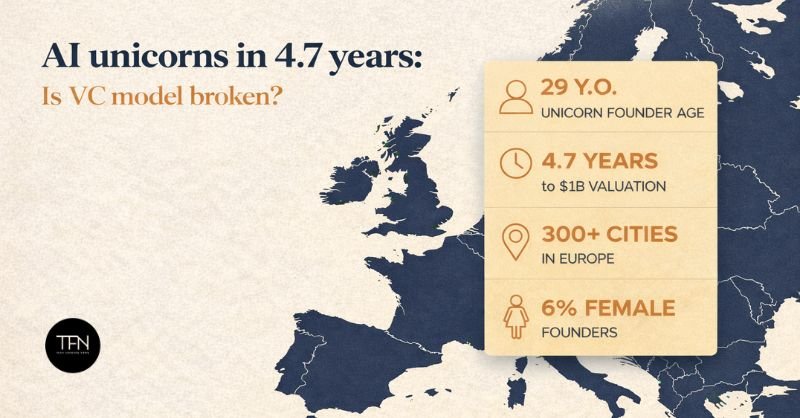
One headline statistic stands out: AI startups reach unicorn status—typically defined as a $1 billion valuation—in an average of 4.7 years. That is nearly two years faster than any other sector, where time-to-unicorn has largely remained stable at roughly six to seven years.
The “great acceleration” in unicorn creation
Unicorns were once rare. Between 2003 and 2013, only about four companies per year crossed the $1 billion mark. Over the past decade, that pace has surged to an average of 148 unicorns per year, a 37-fold increase, according to Antler.
The study argues that each technology wave lowers barriers to entry and shortens the path to scale. In this view, today’s companies are built on an increasingly mature and inexpensive stack—cloud infrastructure, mobile distribution, and now AI—that allows founders to move faster with fewer resources than earlier generations.
Recent examples cited in the report, including Mistral, Lovable, and Suno AI, are presented as signals that the 4.7-year average may compress further as tooling, distribution, and capital adapt to AI-native company formation.
Europe’s execution gap widens as timelines shrink
The acceleration is not evenly distributed. North America and the Asia-Pacific region typically reach unicorn valuations in five to six years. Europe, by contrast, takes more than nine years on average—an execution gap that becomes more consequential when the fastest category, AI, is moving on a sub-five-year clock.
Fridtjof Berge, Co-Founder and Chief Business Officer at Antler, attributes much of the gap to structural issues rather than founder quality. “The difference appears to be driven more by capital structure and market dynamics,” he said. “Later-stage capital in Europe has historically arrived later and in smaller sizes. Since unicorn status is ultimately a valuation milestone, companies in the US often cross that threshold earlier because large growth rounds come sooner.”
Market scale also matters. Berge pointed to China as a driver of faster time-to-unicorn in the Asia-Pacific region, while Europe’s fragmented markets can make rapid scaling structurally harder.
The implication for investors is uncomfortable: funds built around seven-year lifecycles, lengthy diligence processes, and multi-year capital deployment may be mismatched with a world where AI founders can compress “10 years of startup history into two,” as the report frames it.
Younger founders are taking the frontier
Across all sectors, the average age of unicorn founders has risen modestly from 30 to 33 years. In AI, the trend reverses sharply. The average age of an AI unicorn founder fell from 40 in 2020 to 29 in 2024, an 11-year drop in just four years.
About 60% of unicorn founders have STEM backgrounds, and in AI that technical fluency is increasingly treated as a prerequisite. Berge said AI “rewards proximity to the technical frontier,” where hands-on experimentation and model intuition can matter more than seniority. He added that early-stage investors are responding by prioritizing speed and technical depth, which may be amplifying the rise of younger founders in frontier categories.
The study also notes that experience still plays a role: roughly 40% of unicorn creators are repeat founders. But the advantage, it suggests, goes to those who can operate with AI-era iteration speed—regardless of age.
Unicorn creation is spreading beyond Silicon Valley
Geography is another shifting axis. A decade ago, unicorns were concentrated in 30 cities across eight countries. Today, they span more than 300 cities across 45 countries, reflecting a broader distribution of talent, capital, and ambition.
The United States remains the largest single engine of unicorn formation, but its share is declining. In 2012–2014, about two out of every three new unicorns were American. By 2022–2024, that ratio fell to one in two. The absolute number of US unicorns continues to rise, but the global map is diversifying—particularly as China and India produce hundreds of unicorns.
Antler also highlights cross-border founder journeys as increasingly common. The report points to Airalo, which reached unicorn status in 2025, as an example of a globally built company: founder Ahmet Bahadir Ozdemir began in Turkey, built from Singapore, and scaled a global eSIM marketplace internationally.
Immigrant founders and the “policy arbitrage”
The study finds that 26% of unicorn founders are immigrants—people building billion-dollar companies outside their country of birth or primary upbringing. Yet 81% of those immigrant founders are based in the United States, concentrating a major innovation engine within a single jurisdiction.
Antler frames this as an opportunity for other countries: streamlined founder visas, early-stage financing, and network access could redirect future unicorn formation. The report describes a “$100+ billion policy arbitrage” for governments that can reduce friction for globally mobile founders.
Female founders: progress in count, not in share
Female-founded or co-founded unicorns have increased in absolute terms, rising from an average of three per year in 2012–2014 to 17 per year in 2022–2024—a sixfold jump. However, women still represent only 6% of all unicorn founders.
Roz Bazany, Antler Partner and Head of ESG and Impact, argued the gap reflects capital allocation rather than capability. Berge added that the data does not show a region or sector where the share is closing meaningfully; women consistently account for roughly 3–10% of unicorn founders year to year across geographies.
What it means for venture capital
Taken together, the findings point to a market defined by acceleration, broader access to company-building tools, and intensifying competition for frontier talent. The central question is whether venture capital can adapt fast enough—by speeding up decision-making, aligning fund mechanics with shorter scaling cycles, and supporting founders operating in an AI-compressed timeline.
If AI continues to shorten the path to $1 billion valuations, the report suggests, the cost of moving slowly will rise—not just for founders, but for investors and ecosystems that cannot keep pace.
Related