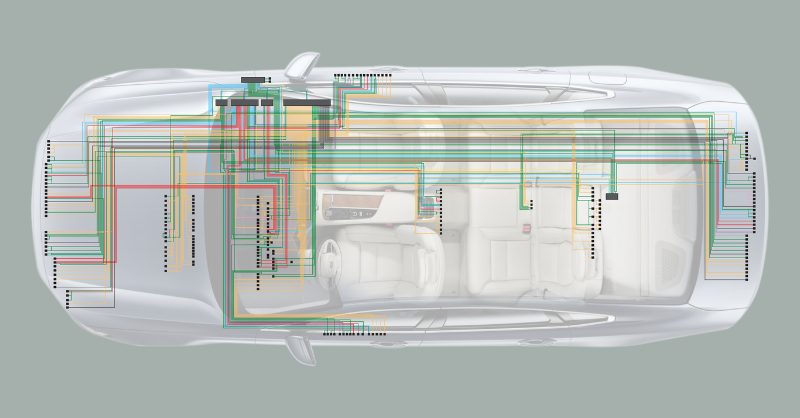
Ethernovia closes $90M Series B to advance automotive Ethernet chips
Ethernovia, a semiconductor startup building high-performance Ethernet networking chips for machines that must react instantly, has raised $90 million in a Series B financing round led by Maverick Silicon. The round also included investment from Porsche SE and Qualcomm, underscoring growing interest in networking silicon that can support real-time artificial intelligence workloads in autonomous vehicles and robots.
The company said the new capital will be used to accelerate development of its Ethernet switching and networking products designed to move data deterministically—on time, every time—across increasingly complex in-vehicle and robotic compute architectures. As automakers and robotics companies pack more sensors, cameras, and AI accelerators into their systems, the internal network has become a critical bottleneck for performance, safety, and cost.
Why in-vehicle networking is becoming a strategic battleground
Modern autonomous and driver-assistance systems generate massive amounts of data that must be transported between sensors, central compute units, and actuators with minimal latency and high reliability. Traditional vehicle networks have relied on a patchwork of protocols and domain-based electronic control units. The industry is now shifting toward centralized and zonal architectures where Ethernet plays a larger role as a unifying backbone.
Ethernet is attractive because it scales well, supports higher bandwidths, and is widely used in data centers and enterprise networks. But automotive and robotics environments impose additional requirements, including deterministic performance, functional safety, and resilience under harsh conditions. That has created an opening for specialized silicon that brings data-center-grade throughput while meeting real-time and safety constraints.
Real-time AI raises the bar for determinism
In robotics and autonomy, delays are not just an inconvenience—they can translate into degraded control, reduced perception accuracy, or unsafe behavior. Real-time AI systems often require predictable delivery of sensor streams and control messages, rather than best-effort networking. As AI models grow larger and sensor suites expand, the internal network must keep pace without introducing jitter or unpredictable congestion.
Ethernovia is positioning its chips as an answer to this challenge, aiming to provide networking components that can handle high-bandwidth data while supporting time-sensitive operation. The company’s focus suggests a belief that networking silicon will be a key enabler of next-generation autonomous platforms, rather than a commodity component.
Investors signal confidence in the Ethernet roadmap
The Series B was led by Maverick Silicon, with strategic participation from Porsche SE and Qualcomm. The presence of both an automotive-focused investor and a major wireless and compute technology player highlights how central networking has become to the broader autonomy stack.
While the company did not disclose valuation or detailed terms in the announcement, the size of the round indicates that investors see significant demand for solutions that can reduce wiring complexity, consolidate compute, and support higher levels of autonomy. In many vehicle platforms, replacing multiple proprietary links with an Ethernet-based backbone can simplify manufacturing and enable more flexible software-defined upgrades over time.
Competition heats up in automotive networking silicon
Ethernovia enters a market where established semiconductor vendors and newer startups are all targeting the same structural shift toward zonal architectures and high-speed in-vehicle networks. Incumbent suppliers have long served automakers with networking components, but the move to higher bandwidths and more deterministic behavior creates room for differentiated architectures, new power-performance tradeoffs, and specialized features.
At the same time, automakers are under pressure to manage bill-of-materials costs and supply chain risk. Networking chips that can consolidate functions, reduce cable weight, and improve reliability may be attractive, but they must also meet stringent automotive qualification standards and long product lifecycles. For startups, winning design slots often requires proving both technical performance and manufacturing readiness.
Robotics expands the addressable market
Beyond passenger vehicles, industrial robots, warehouse automation systems, and autonomous mobile robots are also adopting more advanced sensor and compute stacks. These platforms face similar challenges: they need low-latency connectivity between sensors and compute, and they must operate safely in dynamic environments. A single silicon roadmap that serves both automotive and robotics could broaden Ethernovia’s opportunity, but it also raises execution demands across multiple customer segments.
What comes next
With fresh funding, Ethernovia is expected to push its product development forward, aiming to deliver networking chips that can support the bandwidth and determinism demanded by real-time autonomy. The company’s near-term milestones will likely include completing silicon development cycles, expanding customer evaluations, and progressing through automotive-grade validation processes.
For the broader market, the financing is another indicator that the internal network is becoming as important as the compute itself in autonomous systems. As automakers and robotics firms race to deploy more capable AI, the ability to move data predictably and efficiently may determine which platforms can scale safely—and which suppliers become foundational to the next generation of machines.
Related